LIXIL makes pioneering water and housing products that solve everyday, real-life challenges, making better homes a reality for everyone, everywhere.
Global(EN)
- Global Site
-
- English
- Japanese
- Brand Sites
RESET
Global
- Global Site
-
- English
- Japanese
- Brand Sites
Product Safety & Quality
SHARE


- Last Updated:

Progress in FYE2026 (as of March 31, 2026)
- Quality awareness survey overall positive response score (in Japan)
- 76
Our Approach
At LIXIL, we firmly believe that quality is the foundation of trust with our customers and society, and we are committed to improving product quality and ensuring safety. To consistently pursue the highest-quality manufacturing and services globally, we ensure full compliance with domestic and international standards, such as the ISO 9000 series and the Japanese Industrial Standards (JIS), and have established the LIXIL Quality Principles.
For any critical quality-related issues, we collaborate with our business partners to promote quality management, adhering to the LIXIL Product Safety Principles and our own quality standards, which exceed regulatory requirements.
LIXIL Quality Principles (Opens new window) PDF: 78KB >
LIXIL Product Safety Principles (Opens new window) PDF: 40KB >
Governance Structure
In Japan, LIXIL conducts quality management reviews during quarterly meetings of the Japan Quality Management Committee, driven primarily by the Safety and Quality Management Division. This division is overseen by the Chief Quality Officer (CQO), who reports directly to the CEO. Quality managers of business divisions report to the CQO on progress made toward specific targets set by each division and seek strategic direction to help them deploy quality management systems and address quality-related issues. The CQO reports to the Board of Directors on progress toward targets, audit results, and other important information relating to quality risks, receiving advice and direction from board members.
Quality Management System
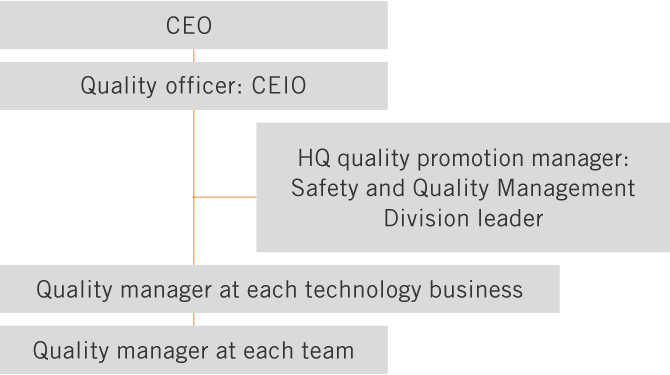
We also conduct annual internal audits of all production sites and subsidiaries in Japan based on the LIXIL Quality Principles and our own quality standards, both of which comply with the ISO 9000 series. All applicable production sites and some subsidiaries in Japan have acquired ISO 9001 certification and regularly undergo relevant external audits.
Product-specific Chief Operations Officers (COOs) manage product quality outside Japan.
Enhancing Quality across the Product Lifecycle
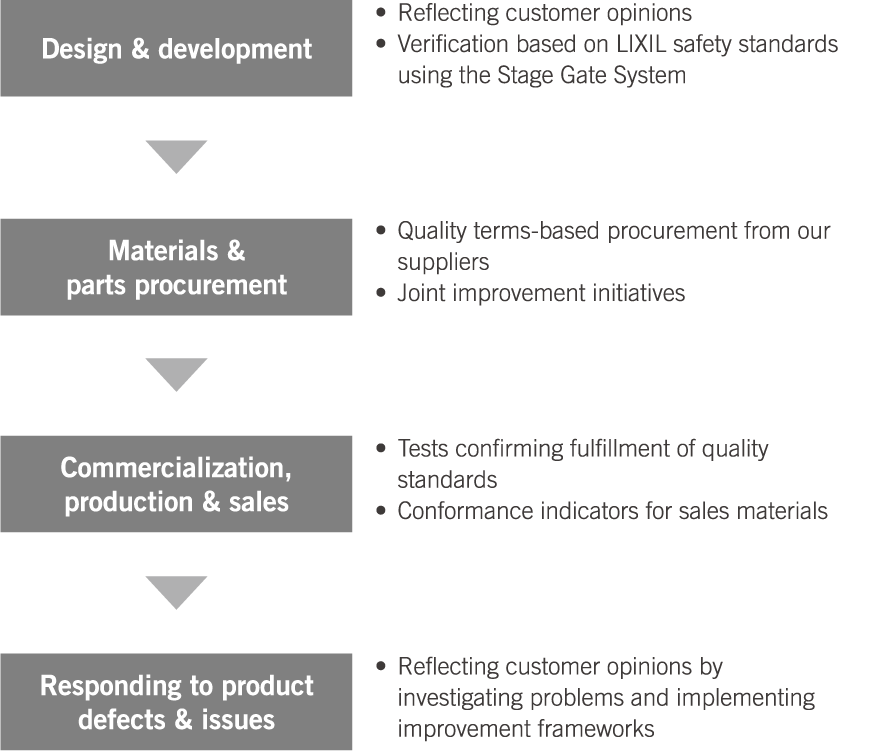
To ensure customer safety, LIXIL is committed to enhancing quality across the entire lifecycle of all products, from design and development to procurement, manufacturing, distribution, and after-sales support.
1) Design and Development
LIXIL has developed robust systems for accurately identifying and ensuring compliance with domestic and international laws and regulations. We integrate globally recognized risk assessment methodologies, such as Fault Tree Analysis (FTA), Failure Mode and Effects Analysis (FMEA), and Design Review Based on Failure Mode (DRBFM), into our design and development processes.
2) Materials & Parts Procurement
We set quality standards for our parts and materials suppliers and verify compliance with those standards through regular quality audits. We also conduct extraordinary audits and implement corrective actions in the event of any change in the 4Ms* in manufacturing processes or when quality-related issues arise. We collaborate with suppliers to drive further improvements by sharing our Procurement Policy and improvement case studies, working together to resolve quality-related issues.
* Four manufacturing elements: Man, Machine, Material, and Method.
3) Commercialization, Production, and Sales
We only commercialize products that have passed rigorous testing under extreme conditions, including durability and weather resistance, to ensure they meet our quality standards. For our distribution processes, we apply a company-wide quality management system (QMS). Under this QMS, we constantly share installation manuals that outline our quality standards with all distributors. To raise awareness of quality management, we hold regular workshops for LIXIL-affiliated distributors and external certified installation partners. Additionally, all relevant employees working at LIXIL-affiliated distributors complete a quality control training program.
Products that require specific labeling to indicate conformance with safety and quality standards are clearly marked with relevant symbols in our catalogs and other sales tools, helping customers select appropriate products. We also strive to improve the clarity of our product explanations through experiential showroom displays and online videos.
4) Responding to Product Malfunctions and Defects
To support the safe use of our products, we provide instruction manuals for all our major products and videos that explain how to care for and clean those products on our website. We also offer the LIXIL Long-Term Warranty Service of up to 10 years to ensure peace of mind over an extended period.
Furthermore, in preparation for the unlikely event of a product-related accident or defect, we have established a comprehensive system to ensure prompt and appropriate response, including a robust communication system for incident reporting, a process for investigating the root cause, the development of recurrence preventive measures, and a mechanism for ensuring their thorough implementation. Through this system, we rigorously investigate the root cause of any defect and implement improvements, not only in product design but also across all processes from manufacturing to distribution. To prevent product malfunctions and defects, we consistently work to advance organizational management to ensure improvement measures are fully sustained and to strengthen governance frameworks that enhance the effectiveness of the QMS. We routinely analyze customer feedback, including opinions and concerns received through channels such as our Customer Support Center, sharing these findings with design and development teams to drive continuous improvements.
Product manuals (Japanese only, opens new window) >
How-to videos (Japanese only, opens new window) >
Improving Product Quality Through Our Stage-Gate System
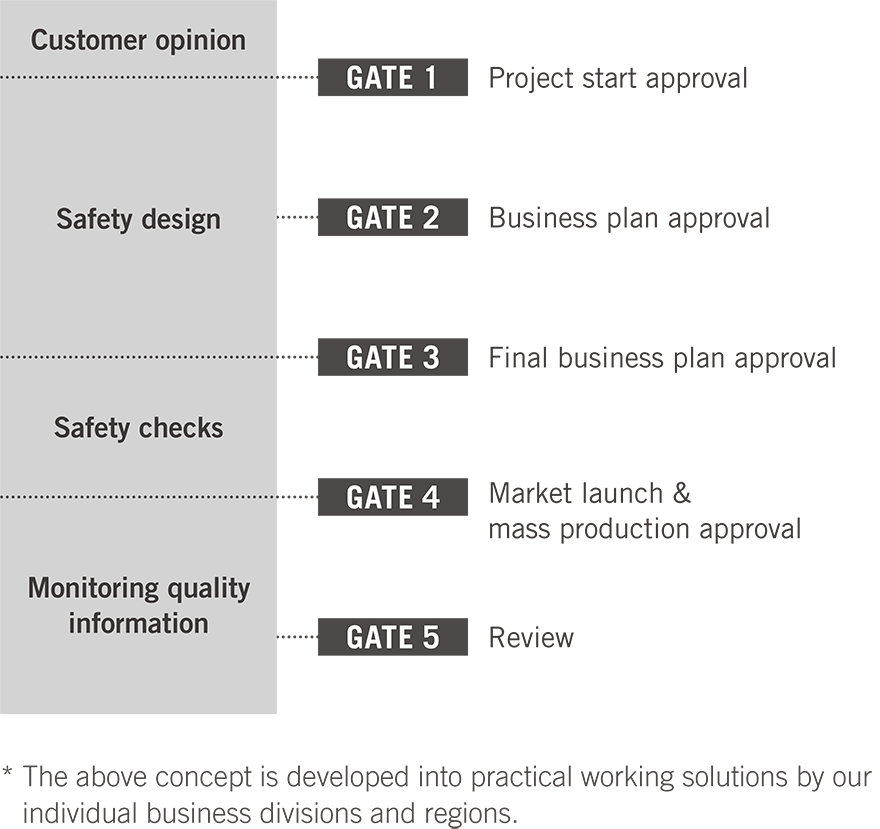
Among our efforts to improve quality across the product life cycle, we have introduced the Stage-Gate System, which separates the various processes involved in product development into different stages, from R&D through to commercialization and merchandising. We are also dedicated to fostering a corporate culture that prioritizes quality from the customer’s perspective.
To raise the level of completion in design, quality, and production, our development, manufacturing, and sales departments work in cross-functional collaboration at each stage of the product development process. Each product is evaluated and discussed at every gate between the stages, and we require formal approval from the quality manager of each business division before moving to the next stage. The evaluation criteria applied at each gate are constantly reviewed to ensure the development of even higher-quality products.
Concept of Stage-Gate System
Pursuit of Superior Quality Product Manufacturing and Services
Quality Control and Product Safety Education
To ensure that our customers can use our products with confidence, LIXIL strives to prevent the occurrence and recurrence of quality defects and product-related accidents. We do this by identifying risks that could cause such defects and accidents, raising employee awareness, and encouraging cross-functional improvement activities throughout the organization. As part of these initiatives, we regularly conduct quality enhancement and product safety training for our employees in Japan.*
These training programs include case studies of past quality defects and accidents, displaying them alongside the actual products and descriptions of their background factors to foster a comprehensive understanding of the root causes of product safety issues.
* Scope: Directly hired employees (including contract employees).

Our archive displaying examples of past quality defects and product-related accidents
Progress in FYE2026:
In Japan, driven by a steadfast commitment to ensuring our products never cause accidents, we are advancing quality-focused human resource development through three key educational pillars:
- “Knowledge Education” to Prevent Quality Non-Compliance
We conduct e-learning programs on risk scenarios that could lead to product-related accidents for sales department employees, which have been completed by 1,189 participants. By analyzing specific hazard cases, this initiative equips employees with the essential knowledge to prevent accidents and raises proactive quality awareness. - “Awareness Education” to Remember Past Lessons
We conduct product safety training themed around past quality defects and product-related accidents at our “Learning from Failures Museum,” with 444 employees participating to date. Through workshops utilizing actual products and case studies, participants examine root causes and develop recurrence prevention measures, translating these lessons directly into everyday workplace actions. - “Technical Education” to Master Quality Practices
We provide in-person training on quality fundamentals for employees in our technology departments—with 4,728 participants trained—aimed at raising quality awareness and developing skills for manufacturing excellence. This empowers each employee to strengthen their ability to enhance quality within their daily operations.
Promoting Internal Awareness Through Information Sharing and Forums
To ensure our customers can use our products and services with complete peace of mind, LIXIL continuously fosters employee quality awareness.
At the center of these initiatives is our quarterly internal publication, the LIXIL Quality Journal. In addition to featuring the LIXIL Quality Principles and executive messages from the CEO, the journal showcases outstanding improvement practices from our global sites to share excellence across the company. By covering a wide range of topics—from manufacturing quality on the shop floor to operational quality in sales—and spotlighting the individual efforts of employees on the front lines, we foster a corporate culture where everyone takes ownership of quality.
Furthermore, we host an annual Quality Forum during Quality Month in November, honoring exceptional improvement activities selected from our global operations to nurture a culture that celebrates challenge and creativity. These ongoing initiatives have led to a steady rise in employee quality awareness scores, while fostering a wave of voluntary, customer-focused improvement activities driven directly by customer feedback.

All-Employee Quality Awareness Survey and Action Plan
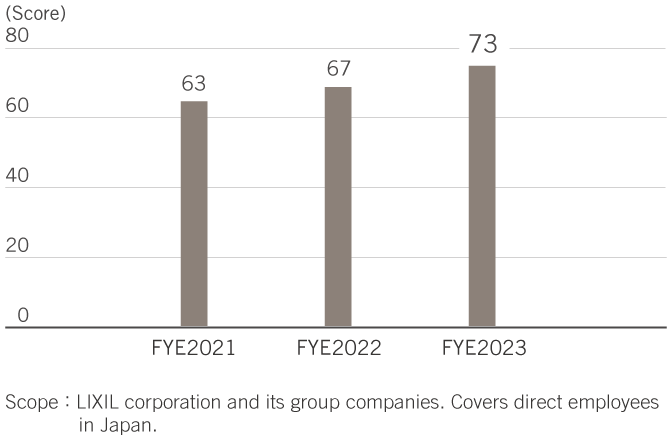
To continuously enhance quality awareness and drive improvement initiatives, we conduct our Quality Awareness Survey for all employees in Japan every year. Based on the results, each department formulates concrete action plans—which include capital investments in manufacturing equipment—to resolve identified issues. As a result, quality-related concerns are being steadily addressed, employee interest has deepened, and quality awareness scores have risen accordingly.
In particular, within manufacturing departments where the survey indicated room for improvement, we have consistently developed quality-focused talent through our “Technical Education” programs aimed at mastering quality practices. This has transformed individual mindsets and behaviors, expanding shop-floor improvement activities and enhancing overall manufacturing quality. Additionally, we host quarterly sessions to share exceptional practices, raising the quality baseline across all operating sites. By linking these initiatives with our annual Quality Forum and the LIXIL Quality Journal, we foster active cross-site collaboration and revitalize improvement efforts, driving a company-wide culture of quality awareness.
Quality Awareness Survey Overall Positive Response Score
Responding to Serious Product-Related Accidents
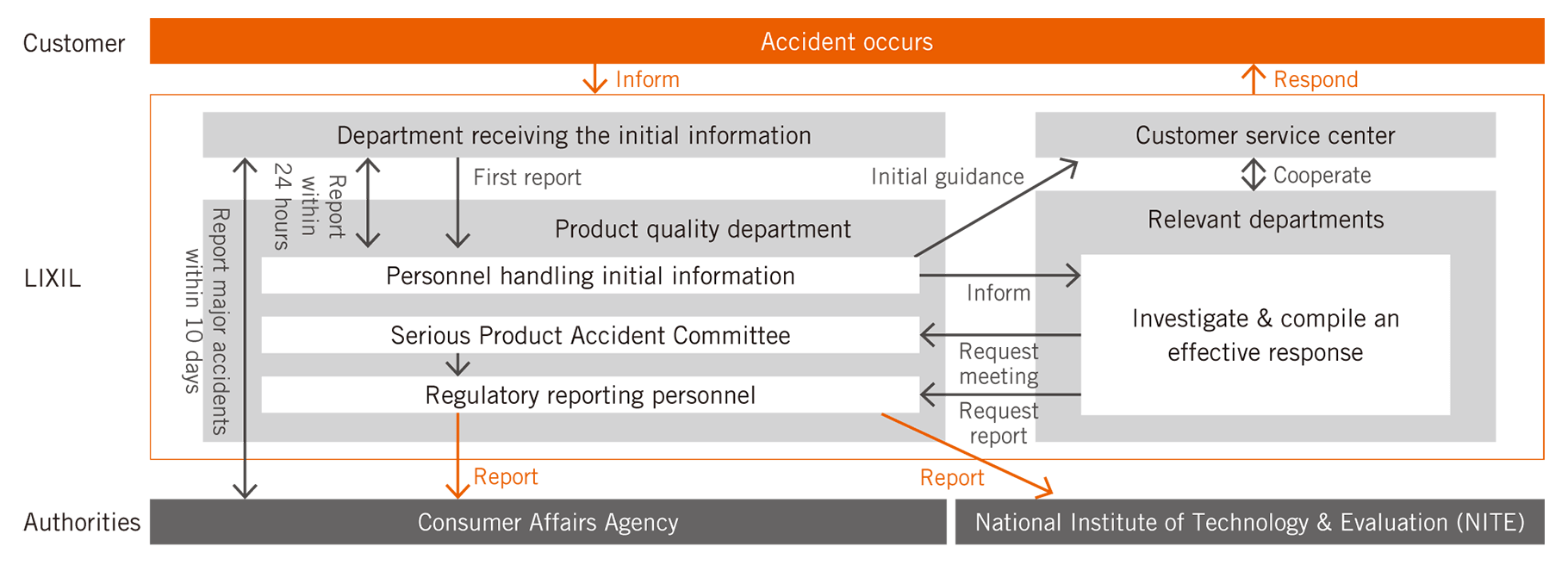
In Japan, whenever a product-related accident occurs, the product quality department collects the relevant information within 24 hours of notification and issues emergency alerts to the relevant departments. If an accident with potentially serious consequences occurs, the department that receives the initial information reports directly to the CEO and the executive officer in charge to ensure an even swifter response. The contact department also cooperates with relevant departments to formulate onsite responses and conduct thorough accident investigations. We submit a report to relevant government authorities within 10 days of receiving the information, as stipulated in Japan’s Consumer Product Safety Act. After completing the emergency response, we work on recurrence prevention by incorporating lessons learned into product design and proactively developing safety technologies to prevent accidents.
Regarding incidents flagged for potential non-compliance with laws or regulations, our technical or other specialized departments will verify compliance and submit a report to the relevant regulatory authorities. As with product-related accidents, we conduct a thorough investigation of the cause and implement appropriate countermeasures to prevent recurrence, ensuring that customers can continue to use our products with peace of mind.
Number of serious product-related accidents and regulatory non-compliance cases
| FYE2024 | FYE2025 | FYE2026 | |
|---|---|---|---|
| Number of serious product-related accidents | 7 | 11 | 9 |
| Number of regulatory non-compliance cases* | 0 | 0 | 2 |
* The number of regulatory non-compliance cases represents incidents under our manufacturing responsibility that violate quality-related laws and regulations. Specifically, it covers cases where corrective action instructions have been issued for products already shipped and in circulation (in the possession of customers), or where the company name has been publicly disclosed by the competent ministries or agencies.
Emergency Procedure for Responding to Accidents
Awareness-Raising Activities to Prevent Accidents at Home and in Schools
In Japan, approximately 17,000 people die each year from accidents in the home, which is roughly five times the number of traffic fatalities. To address this, LIXIL is committed to raising consumer awareness of product safety and preventing accidents in the home through various educational initiatives.
Since 2013, we have conducted product safety seminars tailored to specific audiences, including senior citizens and educators. In 2014, we began distributing free educational DVDs for use in schools and conducting outreach classes led by our employees. We have continued to expand the reach of these initiatives, including the introduction of remote learning programs for elementary schools in underpopulated areas in 2022 and focusing on accident prevention in both schools and homes.
Developing Teaching Materials and Outreach Classes for Children
- Total Number of Outreach Classes and Participants
- 675 classes, 24,185students
Safety in the Home: Safety Education Program
Our employees visit elementary and junior high schools across Japan to conduct outreach classes for students. To date, we have held 675 classes, with 24,185 students participating. In classes for elementary school students, we use our own developed animation videos to teach them about hidden dangers in the home, encouraging them to proactively think about, and implement, ways to prevent accidents. In classes for junior high school students, participants examine hidden dangers in the home and consider safety measures from the perspectives of both residents and product developers, providing an opportunity for them to envision future career paths as developers.
Learn more about Safety Education Program (Japanese only, opens new window) >
Education Program to Keep Schools Safe
Dangers lurk not only in the home but also at school. In Japan, approximately 270,000 children are injured annually under school supervision at elementary schools, highlighting the growing importance of safety awareness in daily life. In this context, LIXIL developed the “Education Program to Keep Schools Safe,” offering three sub-programs focused on the school environment where children spend a significant portion of their day.
Our outreach classes using this program emphasize “helping children view accidents as personally relevant”—a key challenge in safety education. By visualizing physical, mental, and social risks, the program aims to strengthen children’s ability to identify and assess potential hazards. Our employees currently deliver these outreach classes at schools across Japan.
To bridge regional gaps in learning opportunities, we have also offered online classes since 2022, expanding access to safety education for even more children. To date, we have conducted 38 online sessions, reaching a total of 877 elementary school students.
We jointly developed these teaching materials with Shizuoka University and Waseda University. Additionally, the online classes are delivered in partnership with the general incorporated association “Professionals for All Schools.” We continuously improve the quality of our educational content by collaborating with these specialized institutions.
Learn more about School Safety Education Program (Japanese only, opens new window) >
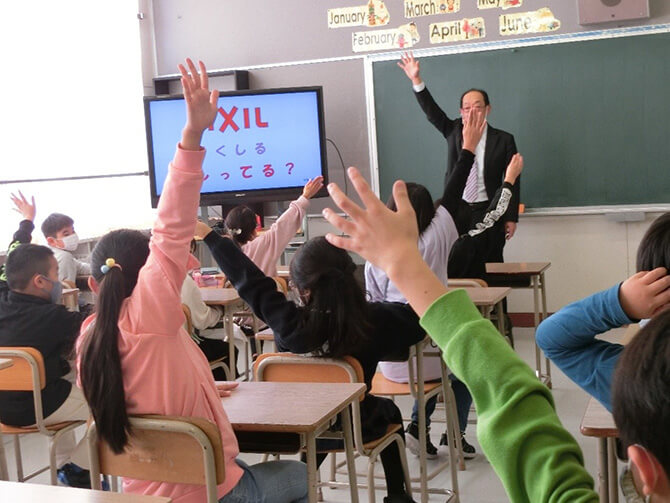
Outreach classes
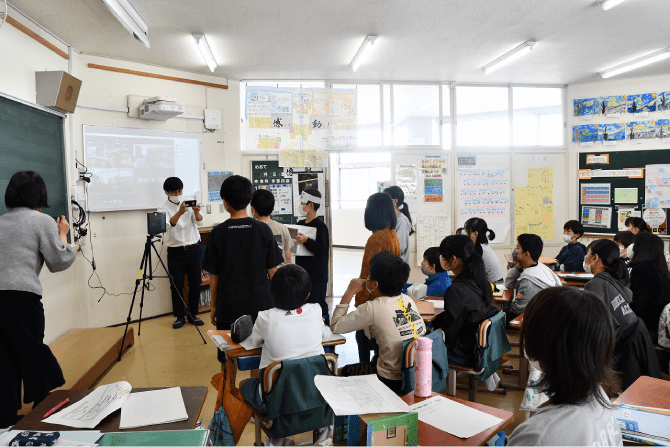
Online lessons
Seminars for Consumers
We encourage consumers to think about preventing accidents at home by giving lectures at product safety seminars hosted by the National Federation of Women’s Organizations and other consumer organizations nationwide. The seminars cover topics such as accidents in toilets and bathrooms, tripping over steps, and falls.
In FYE2026, we held 25 sessions with 1,118 participants in attendance, bringing the cumulative total to 10,989 participants over 136 sessions to date.
- Total Number of Seminars and Participants
- 136 sessions, 10,989people
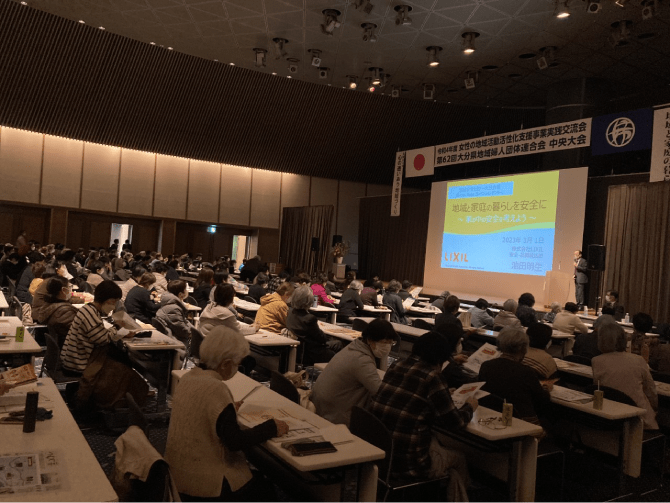
Product safety seminar
External Evaluations & Awards
LIXIL has been awarded the Minister of Economy, Trade, and Industry Award in the Large Enterprise Manufacturer/Importer Category of the 2024 Product Safety Measures Award program, sponsored by Japan’s Ministry of Economy, Trade and Industry. This prestigious award recognizes LIXIL’s initiatives in ensuring proper installation and accident prevention through digital transformation (DX), designing and developing safer products using CAE analysis, and actively working to improve product safety through the establishment of product safety standards and outreach classes.
Our safety education materials for elementary school students have won the Award of Excellence for two consecutive years at the Commendation on Instructional Materials for Consumer Education conducted by the National Institute for Consumer Education.
Furthermore, the education program, developed jointly with Shizuoka University and Waseda University to help children view accidents as personally relevant, received the Kids Design Award in FYE2026.
Received the Minister of Economy, Trade, and Industry Award in the Product Safety Measures Award program. (Japanese only, opens new window) >
Received the 19th Kids Design Award >


SHARE
 Official Page